University of Washington Microcellular Plastics Lab
I worked at the Microcellular Plastics Lab through my senior year at the University of Washington. During this time my focus was mainly to bring an old thermal conductivity measure apparatus back to life, which was made in the lab many years before I started there. The device had not worked for a few years before I started and it took about 3 months to be able to revamp the hardware, software and to be able to have consistent results. Once we were able to use the device I spent a lot of time running test and characterizing different Microcellular Plastics against virgin plastics to see if the foaming process had any impact on the the thermal characteristics as support for one of the masters student.
I also worked on the extrusion of Microcellular Plastics with the doctoral candidate in the lab, and research to create open cell foams from closed cell foams using ultrasound.
My senior capstone project eventually stemmed from this lab as MicroGreen, the company which started due to the invention of the Microcellular Plastics process, was looking for applications for the plastics. More information on my capstone project can be found in the "Capstone Project - MABS Canoe" section.
A little background on Microcellular Plastics:
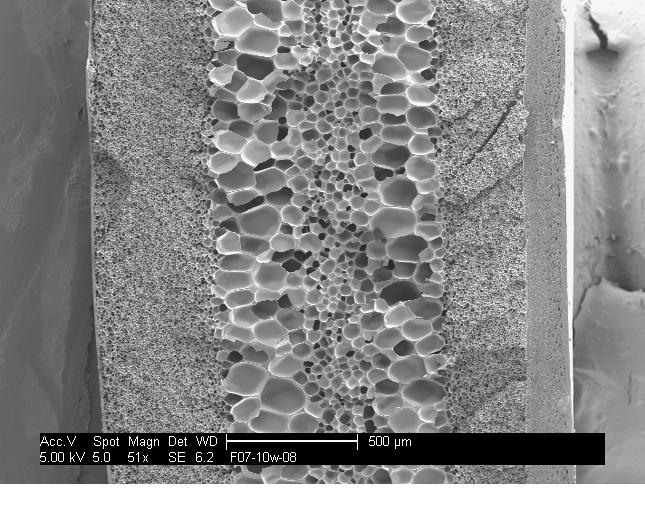
Microcellular plastic is made by saturating a given plastic with carbon dioxide in a pressure vessel. Once the plastic is saturated heat is applied to the plastic to bring it above it's glass transition temperature allowing the carbon monoxide to expand and quickly leave the plastic, leaving microscopic bubbles in the plastic. A beneficial outcome of this process is that there is a gradient in the bubble density and size throughout the plastic, there are more and larger bubbles in the middle and no bubbles on the edges. This creates a tough skin on the outside of the material and a microscopic cell structure in the middle. By varying the saturation time and pressure along with the foaming time and temperature the size and density of the bubbles can be controlled along with the skin thickness. A cross sectional image can be seen below.